Stranded Marine Mammal Rescue - Global
When the tide is low, the stakes are high for marine mammalsWorld Oceans Day marks launch of first national association for marine mammal responders
World Oceans Day marks launch of first national association for marine mammal responders
June 8, 2026
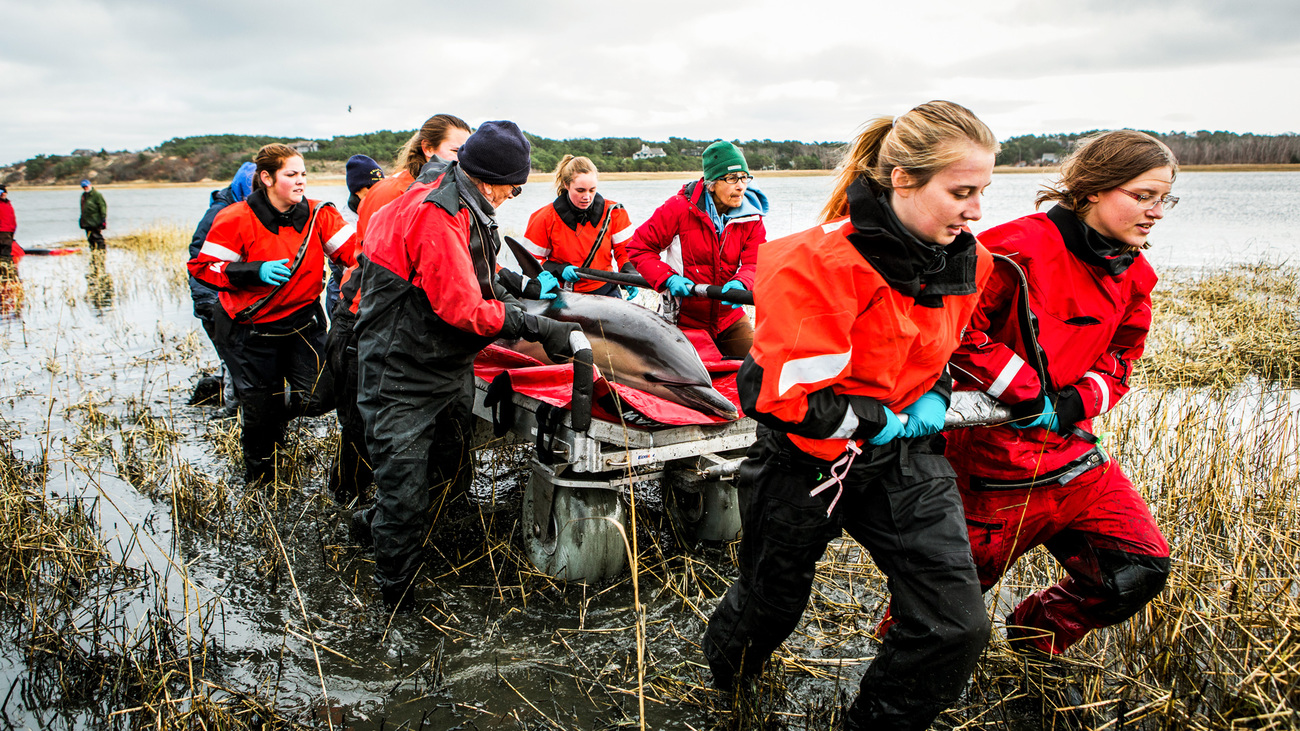
IFAW's Marine Mammal Rescue team responding to a stranding of four male dolphins in Wellfleet, MA, in 2018. Photo: © Andrea Spence, Activities conducted under a federal stranding agreement between IFAW and NMFS under the MMPA.
(June 8, 2026 – Washington, DC) — Launching today on World Oceans Day, a new association will unite groups nationwide to strengthen marine mammal rescue and response, improve coordination and training, and support the long-term health of marine mammals and ocean ecosystems across the United States.
The launch of the National Marine Mammal Stranding Association (NMMSA) follows months of planning by a nationally representative steering committee and finalization during Capitol Hill Ocean Week this June, where marine mammal stranding response leaders from across the US gathered in Bethesda, Maryland to advance the initiative.
“The genuine camaraderie and collaboration at this initial meeting are exactly the goal of the Association,” said Katie Moore, Senior Director of Animal Rescue at the International Fund for Animal Welfare (IFAW) who helped spearhead the effort and serves on the founding steering committee. “We know that by working together, we can have a greater impact. This effort reflects a shared commitment across the response community to strengthen collaboration, support responders on the front lines, and improve outcomes for marine mammals and the ecosystems they inhabit.”
The initiative has strong support across the existing marine mammal stranding response network, with recent polling showing that 94% of respondents recognize the need for a national association.
Marine mammal stranding response in the US operates under the framework established through the Marine Mammal Protection Act, NOAA Fisheries’ Marine Mammal Health and Stranding Response Program (MMHSRP), and the US Fish and Wildlife Service (USFWS). Organizers say NMMSA is intended to complement that federal framework by strengthening collaboration, training support, communications, and resource sharing across the response community.
“Marine mammal stranding responders play a critical role in increasing knowledge of marine mammals and advancing our understanding of ocean and ecosystem health,” said Sarah Wilkin, coordinator of the MMHSRP at NOAA Fisheries. “Efforts that strengthen collaboration, communication, and shared expertise across the stranding response network can help improve response capacity and support the long-term conservation of marine mammal populations.”
Core services under development for the Association include capacity building and professional development, communications tools, shared technical resources, new funding pathways, public education, and policy engagement. Organizers intend to establish the group as a 501(c)(3) nonprofit organization.
"The Marine Mammal Center is proud to serve as fiscal sponsor for this initiative, helping to provide the organizational foundation needed to turn this vision into reality," said Dr. Jeff Boehm, Chief External Relations Officer at The Marine Mammal Center. "We've seen firsthand how much this network accomplishes with limited resources. By giving individuals and institutions a way to invest in this effort, we can help build something that strengthens marine mammal rescue and response for years to come. We invite anyone who cares about ocean health to join us in making this association a success.”
The National Marine Mammal Stranding Association was developed by a nationally representative steering committee of marine mammal response leaders from across the United States. The group's June 1 meeting in Bethesda, Maryland, held during Capitol Hill Ocean Week and supported through a NOAA John H. Prescott Marine Mammal Rescue Assistance Grant, helped lay the foundation for a stronger, more connected national response network.
Note to editors
The National Marine Mammal Stranding Association steering committee is made up of members from The Marine Mammal Center (fiscal sponsor), Mote Marine Laboratory, Atlantic Marine Conservation Society, Cascadia Research, University of Hawaii, Alaska Veterinary Pathology Services, IFAW, and Whale and Dolphin Conservation. The committee surveyed marine mammal stranding responders to determine the greatest needs of network members.
For more information visit: National Stranding Association | The Marine Mammal Center.
Visual editors may view and download photos and caption credits here: https://spaces.hightail.com/space/xtsM0EPL10
Press contact:
Stacey Hedman, IFAW, shedman@ifaw.org, +1 508 737 2558
Giancarlo Rulli, The Marine Mammal Center, media@tmmc.org, +1 415 754 4012
Related content
Our work can’t get done without you. Please give what you can to help animals thrive.